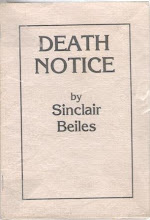
Sinclair Beiles, who died on November 3 [2000] at the age of 70 in Johannesburg Hospital, was one of South Africa’s more unusual and often underrated poets. He was the first winner of the Ingrid Jonker Memorial Prize for poetry in 1970, but in later years was reduced to photocopying his poetry and plays and donating them to libraries to ensure, as he put it, that they would go on record.
Beiles was born in Kampala, Uganda, and educated in South Africa. During the 1950s and 1960s he travelled the world, establishing links with the beat generation of writers, particularly William Burroughs. He collaborated with Burroughs and artist Brion Gysin on early experiments with cut-ups – work in which the text was chopped up and then reassembled semi-randomly. The results of their first experiments were published as
Minutes to Go. Burroughs continued to use this technique throughout the Sixties. Beiles also worked with Burroughs on the composition of
Naked Lunch, in Tangier in the late Fifties, along with Allen Ginsberg and Jack Kerouac, and helped get it published by Maurice Girodias’s Olympia Press in Paris (where Beiles later stayed in the famous “beat hotel” along with Burroughs and Gysin).
Naked Lunch went on to become one of the most influential texts of the Sixties counterculture and subsequently post-modern literature in general.
Beiles’s own poetry made less use of an intentional cut-up technique, but reflected a lack of concern with traditional poetic virtues, relying instead on raw energy and an immediate unedited apprehension of the poet’s reality. Beiles’s 1969 volume,
Ashes of Experience, was his first substantial publication, written largely during a stay in Greece.
Beiles returned to South Africa in the Seventies and became a fixture of the Yeoville
demi-monde in the Eighties. He often performed his poetry live, at venues such as the Black Sun, and was memorialised in Anton Kotze’s documentary
Sacred Fix. He continued to write prolifically until his death. Among his later publications were the plays in verse,
The Needle Vestel and
Three Plays: Picasso as told by Max Jacob, and the poetry collections
The Golden Years and
Aardvark City. His selected poems were published in the US under the title
A South African Abroad.
‘The Beats are traditional writers,’ said Beiles, ‘and among our tradition I am the only one who has chosen Chaucer as my model. Like Chaucer I am both classical and spontaneous. My role is as a pure poet. I don’t do anything but poeticise.’
He was buried on November 7 in West Park cemetery.
(Published in Mail & Guardian, November 10 2000)


 Sinclair Beiles (b. Kampala, Uganda, 1930, d. 2002, Johannesburg) - was a South African beat poet and editor for Maurice Girodias at the Olympia Press in Paris. He developed along with William S Burroughs and Brion Gysin the cut-up technique of writing poetry and literature.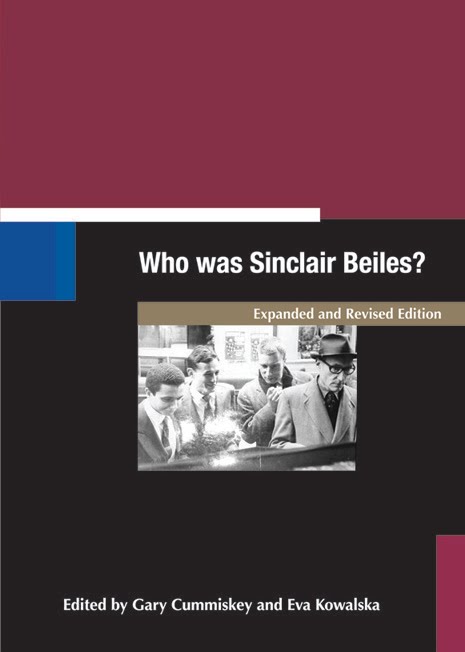

.jpg)