Sunday, March 18, 2012

The Idiot's Voice on Longhouse Poetry and Publishers

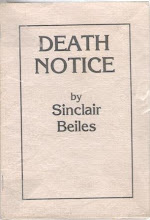
Let me utter my last words
in a taxi cruising slowly through
the beautiful posies of neon signs.
Let someone else die in my room
on the turned mattress
so it doesn't show stains.
Let him savor the smell of it.
The smell of old lemons and let his last
moments be guillotined by badly
played guitars in other rooms.
In readiness I have a shirt with the black
ring scrubbed off the collar and a suit
which was shiny before I sandpapered it.
And now I must find my last words....Read more here

Sunday, February 26, 2012

Unisa Archives - Sinclair Simon Maurice Beiles Papers

The Sinclair Beiles Papers, which comprise 0,2 linear metres, were donated to the Unisa Library Archive by Dawie Malan in 2001. The Beiles papers include interesting correspondence, manuscripts, photographs, pamphlets, posters and eleven sketches. The papers throw some light on the enigma of Sinclair Beiles ( 1930-2000). Read more here

Wednesday, January 25, 2012

The Idiot's Voice - a collection of previously unpublished poems by Sinclair Beiles

The Idiot's Voice is a collection of 25 previously unpublished poems by Sinclair Beiles.

Published by Cold Turkey Press, France, the first edition is limited to 36 copies.

Cost is 15 euros, excluding postage.

For order information, contact coldturkeypress@gerardbellaart.com

Thursday, November 24, 2011

Letter to Gerard Bellaart from Sinclair Beiles, 1970


Courtesy of the Cold Turkey Press archive

Saturday, October 29, 2011

Sinclair Beiles, Action Poet by Shaun de Waal

South African poet and writer Sinclair Beiles has not always received favourable attention in his home country. Now, however, he and his work have been placed at the centre of a major celebration of the Beat Generation and The Beat Hotel.

The Institut Francais d'Afrique du Sud, in conjuction with the British Council, has put together a range of events that includes an exhibition of photographs by Harold Chapman, a partial reconstruction of the famous Beat Hotel, films including a documentary on Beiles, a multimedia show, and a lecture by Donald Moerdijk (born in South Africa, he is now a professor at Paris's Ecole Normale Superieure).

The Beat Hotel - a pension on Paris's Left Bank, at 9 Git-le-Coeur, run by the accommodating Mme Rachou - came to be nicknamed due to the transient artists and writers it housed, among them William Burroughs, Harold Norse, Allen Ginsberg, Brion Gysin, Gregory Corso and of course Beiles.

Beiles, a South African born in Uganda,collaborated with Burroughs, Gynsin and Corso on Minutes To Go, a slender volume of poetry made using a revolutionary method - the cut-up.

Burroughs, particularly, took to the concept of chopping up pieces of text and reassembling them at random. "Cut the word-lines" he would later urge, theorising that the bizarre new meanings thrown up by such a poetic method would help subvert the agents of social control, one of whose tools, it was believed, was "rational" language.

When I interviewed Beles some years ago, he began by flipping through some old volumes of his work, reading snippets from each, in arbitrary order, into a tape recorder - producing an impromptu cut-up.

This method of composition, however, was only one element of Beiles's work. His 1969 collection of poems, Ashes of Experience, which won the Ingrid Jonker Prize, has enough of a sense of detachment without requiring the physical fracturing of the text:

And the women smile from their doorways
at the stranger
who carries his heart
in his hand.
He walks about the marketplace
as if risen from the dead
an ancestor
come to see his people
trading old coins
stamped in his likeness.

"I was coming from absolutely nowhere," Beiles told me. "I found myself an exile in Athens. No books, no clothes, no possibility of integrating myself into society. I had a notebook and a pencil, but knew hardly anybody. I started writing one or two poems a week in between wandering around aimlessly in Athens. Occassionally I showed poems to people in cafes and got a drink or something to eat in return."

(Published in Mail & Guardian, January 30, 1997)  

Thursday, October 13, 2011

Sinclair Beiles, 1972


Courtesy: James de Villiers

Thursday, September 22, 2011

Beiles's Sacred Fix and other hits on auction in New York, by Mike Alfred

Sinclair Beiles, South Africa's own Beat poet, believes that when Paul Getty bought a first-edition Chaucer and Harry Oppenheimer bought the manuscript of Cry, The Beloved Country for large sums, such purchases marked a growing interest in the commercial exchange of literary memorabilia.

Beiles has just been invited to submit items to be included in a Sotheby's New York auction of Beat poets' original renderings and associated objects. The sale is scheduled for October 6 and according to Beiles is likely to signal the upsurge of a spate of millenial interest in the authors of the 20th century. "I think people are getting tired of bidding for furntiture," ventures Beiles.

Apparently not all that appreciated in South Africa, land of Beiles's birth and education at King Edward high school and Wits university, he is better known and recognised for his work in Europe where he associated with such notables as William Burroughs, Harold Norse and Allen Ginsberg. 

Indeed, it is Bill Morgan, the archvist of the Allen Ginsberg Trust, who has invited Beiles to submit items for sale in association with other well-known Beat poets. Beiles observes that while his work features in the "Whitney Museum's handsome book on the Beats",  his contribution has been ignored by the compilers of A Century of South African Poetry.

Among the items Beiles is submitting is his critically acclaimed Sacred Fix, published by Cold Turkey Press, Rotterdam, 1975. Also to appear is his current favourite, Springtime at Raubenheimer's, a limited edition of short, humorous poems published last November.

Sotheby's has placed a $1 000 reserve on each lot and Beiles is submitting a number hopefully calculated to alleviate the cliched plight of the impecunious poet.

Beiles asserts that it is high time poetry was recognised as offering some genuine financial worth.

(Published in The Sunday Independent, July 25 1999)

Glad of my Fever


A poem card published in a limited edition by Cold Turkey Press, France

Wednesday, September 7, 2011

Beiles collection published in USA, by Percy Baneshik

The poet most markedly without honour in his own country, Sinclair Beiles, has once again demonstrated that, as prophets go, he is distinctly not without honour in the outer world.

This time the recognition comes in the shape of a new book, published by Lapis Press in Venice, California, rounding up a selection of his verses over several decades.

Though the volume bears a somewhat uninspiring title, A South African Abroad, it comes with a resounding accolade from the publishers, who happen to be of a particularly selective frame of mind in their publishing. They specialise in publishing contemporary poetry by leading poets of the day.

The foreward to the book is contributed by Nanos Valaoritis, professor of world literature at San Francisco State University.

Why the rather flat title? Certainly the poetry is a reflection of Beiles's sojourns abroad in countries ranging from Greece to Spain, Italy, Tangier and a few other areas of reflective wanderering. But the title is a sort of poetic inversion.

In Valaoritis's lengthy introduction, the inversion becomes clear."Sinclair", says Valaoritis, "takes the South African experience as a springboard to symbolise all oppression, all persecution, all bad taste,all flattening-out uniformity, and all monsterous brain-washing..."

The professor categorises the Johannesburg poet as "an internal exile in South Africa", speaking of  "the taste of euphoric exile in all of his poems" which derive from his wanderings, "always de passage from one place to another".

Valaoritis cites Beiles's "political moments", declaring downrightly "I wouldn't say Sinclair is a hero like Breytenbach... but he is, in his best moments, as good a poet..."

In light of this assessment, appearance of the collection in California strikes a special note. It underscores the fact that, strangely, Beiles has never been included in an anthology of South African poetry.

He has won prizes like the Ingrid Jonker Memorial Award, the William Plomer Award and the Lord Byron Award, a prize handed out by the French Friends of Lord Byron Poetry Society, which Beiles won for his 1976 collection, Sacred Fix. Other recipients of this award have been TS Eliot and Robert Graves.

But election to a locally compiled anthology of poetry has eluded him.

He has wondered about this, pointing out that publication in local anthologies is the most important way of getting known by students, who are the main readers of poetry.

The new collection, A South African Abroad, culled from volumes Beiles has brought out in South Africa over the years ... will be published by Lapis Press...Priced in the US  at $12,95 (approx R33). It will be avaulable in bookstores in South Africa soon.

(Published in The Star, February 14, 1991)

Friday, September 2, 2011

Following the flight path of the poet's imagination: Robert Berold's review of A South African Abroad

Sinclair Beiles grew up in South Africa and went into exile in his 20s. By 1958, aged 28, he was in the midst of the international avant-garde, working for the Olympia Press in Paris, living in the famous Beat Hotel, collaborating on the cut-up work Minutes To Go with William Burroughs, Brion Gysin and Gregory Corso. In the 1960s he migrated to Greece and Tangiers: by all accounts one of the proto-hippies.

In 1969 Beiles's first collection of poetry, Ashes of Experience, was published in Souh Africa by Wurm. Five more books followed. Beiles returned from exile a few years ago and now lives in Johannesburg, where he is active in poetry readings and poetry/jazz performances.

This selection, elegantly produced by Lapis Press, is a mark of the international recognition that Beiles has received. It also begs the question why his work does not appear in any of the standard anthologies of South African verse. Could it be that South Africa is not ready for his knd of pransker surrealism?

This is not the kind of poetry we are used to, but that does not make Beiles a bad poet. The poems in A South African Abroad are literate and readable explosions. They are poems with a sense of humour - even better,a  sense of fun. They work through a loose surrealism, like playfulness reminiscent of French poets like Cendrars or Michaux.

It may seem that the poems go off on tangents which go off on further tangents until the subject is lost.  To look at them this way is to misread them. The real subect is the flight path of the poem's energy ( the aeroplane image is the poet's):

My condition is lamentable - to me anyway.
I keep a kind of old flying machine stability
On a cupboard full of drugs
And as I fly through the day
I can hear my nerves creaking...
If some small magazine editor happens to
drop into your office
Or into your soup in the form of a fly when
You eat at
The arts laboratory
Perhaps you can pull out this work for his
consideration.
Tell him I have terrible dreams.
 
(from 'Terrible Dreams')
 
Admittedly whem this type of poetry doesn't take off, it crashes: as in the rhymed poems about the crucifixion. But most of the time it is full of unexpected pleasures:
 
You can meet someone on the train
And forget about your brokenheartedness.
Now affairs on trains are permissible.
But they will break up.
There's either not enough money to pay for the fare
Or not enough love.
"Goodbye lost love alone on the railway station!"
Maybe you'll die on the railway station
Like Tolstoy clutching an icon.
Or maybe you'll start another affair
Perhaps with a farmer who's come to collect
A prize cow from the goods train.
Life on a farm is not too bad.
There are no traffic lights but there are compensations.
Both the railways and God help the brokenhearted.
See the view from the train window!
Poppies!Yellow grass!
 
(from 'Brokenhearted Travellers')  
 
A South African Abroad, despite its title, has almost nothing in its content identifiably South African. But there is something about its style - naive recklessness, joller instinct - which is distinctly of this country. In this Beiles is as tuned in to the mind of South Africa as many a poet of irony or outrage. A selection of his work needs to be republished here, especially since the imported price of this book, about R50, is prohibitively expensive.
 
(Published in The Weekly Mail, 27 September 1991)