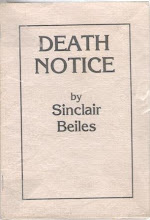
South African poet and writer Sinclair Beiles has not always received favourable attention in his home country. Now, however, he and his work have been placed at the centre of a major celebration of the Beat Generation and The Beat Hotel.
The Institut Francais d'Afrique du Sud, in conjuction with the British Council, has put together a range of events that includes an exhibition of photographs by Harold Chapman, a partial reconstruction of the famous Beat Hotel, films including a documentary on Beiles, a multimedia show, and a lecture by Donald Moerdijk (born in South Africa, he is now a professor at Paris's Ecole Normale Superieure).
The Beat Hotel - a
pension on Paris's Left Bank, at 9 Git-le-Coeur, run by the accommodating Mme Rachou - came to be nicknamed due to the transient artists and writers it housed, among them William Burroughs, Harold Norse, Allen Ginsberg, Brion Gysin, Gregory Corso and of course Beiles.
Beiles, a South African born in Uganda,collaborated with Burroughs, Gynsin and Corso on
Minutes To Go, a slender volume of poetry made using a revolutionary method - the cut-up.
Burroughs, particularly, took to the concept of chopping up pieces of text and reassembling them at random. "Cut the word-lines" he would later urge, theorising that the bizarre new meanings thrown up by such a poetic method would help subvert the agents of social control, one of whose tools, it was believed, was "rational" language.
When I interviewed Beles some years ago, he began by flipping through some old volumes of his work, reading snippets from each, in arbitrary order, into a tape recorder - producing an impromptu cut-up.
This method of composition, however, was only one element of Beiles's work. His 1969 collection of poems,
Ashes of Experience, which won the Ingrid Jonker Prize, has enough of a sense of detachment without requiring the physical fracturing of the text:
And the women smile from their doorways
at the stranger
who carries his heart
in his hand.
He walks about the marketplace
as if risen from the dead
an ancestor
come to see his people
trading old coins
stamped in his likeness.
"I was coming from absolutely nowhere," Beiles told me. "I found myself an exile in Athens. No books, no clothes, no possibility of integrating myself into society. I had a notebook and a pencil, but knew hardly anybody. I started writing one or two poems a week in between wandering around aimlessly in Athens. Occassionally I showed poems to people in cafes and got a drink or something to eat in return."
(Published in Mail & Guardian, January 30, 1997)


 "In 1959, he (Richard Wright) was introduced to haiku by Sinclair Beiles , a young South African poet who loved its form. Beiles was living in Paris and associating with other poets of the 'Beat generation' such as Jack Kerouac, Allen Ginsberg, William Burroughs and Gary Snyder. Beiles's and the Beat poets' interest in Zen led Wright to the knowledge of haiku. Because the Beat Hotel was in the Latin Quarter and Wright lived very close to the hotel, Wright often frequented the hotel bar....Wright borrowed, from Sinclair Beiles, RH Blyth's four volumes on the art and history of the haiku and its relationship to Zen philosophy and settled down to rediscover his old dream of oneness with life..."
 Courtesy: Unisa library archives - manuscript collection ACC143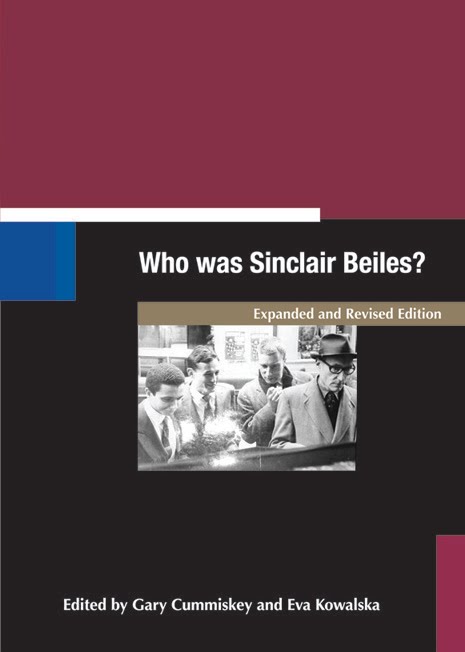

.jpg)