Showing posts with label Harold Norse. Show all posts

Sunday, July 21, 2024

Bukowski mentions Beiles reviewing Penguin Modern Poets 13

 'also Penguin Poetry [sic] 13 is out. but it won't be published in U.S. until June 26, this year. Bukowski-Norse-Lamantia. but we are already in trouble. the slick-poetry academy boys and poets are already after our asses. Sinclair Beiles wrote a good review of Penguin 13, said it was the best of the series, but London Magazine refused the print the review and Beiles sent it to a South African paper which also refused to publish the bit. Beiles wrote Norse that he thought Hal and I were the best living writers using the English language ...'

Letter to Jon and Louise Webb, Feburary 5, 1969

(published in Charles Bukowski, Selected Letters, Volume 2: 1965-1970, edited by Seamus Cooney, Virgin Books, 2004.) 


Saturday, October 29, 2011

Sinclair Beiles, Action Poet by Shaun de Waal

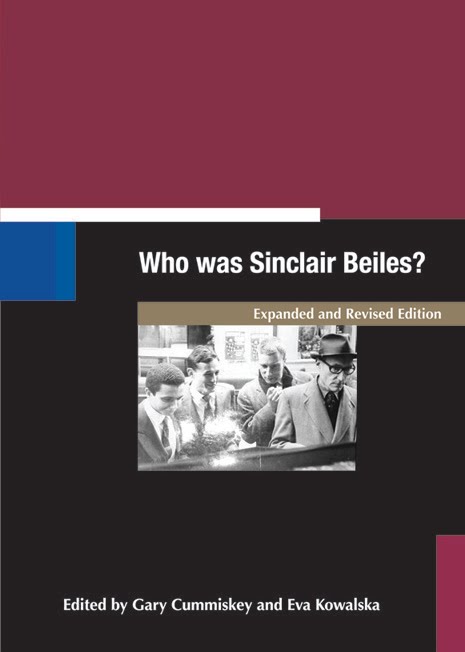
South African poet and writer Sinclair Beiles has not always received favourable attention in his home country. Now, however, he and his work have been placed at the centre of a major celebration of the Beat Generation and The Beat Hotel.

The Institut Francais d'Afrique du Sud, in conjuction with the British Council, has put together a range of events that includes an exhibition of photographs by Harold Chapman, a partial reconstruction of the famous Beat Hotel, films including a documentary on Beiles, a multimedia show, and a lecture by Donald Moerdijk (born in South Africa, he is now a professor at Paris's Ecole Normale Superieure).

The Beat Hotel - a pension on Paris's Left Bank, at 9 Git-le-Coeur, run by the accommodating Mme Rachou - came to be nicknamed due to the transient artists and writers it housed, among them William Burroughs, Harold Norse, Allen Ginsberg, Brion Gysin, Gregory Corso and of course Beiles.

Beiles, a South African born in Uganda,collaborated with Burroughs, Gynsin and Corso on Minutes To Go, a slender volume of poetry made using a revolutionary method - the cut-up.

Burroughs, particularly, took to the concept of chopping up pieces of text and reassembling them at random. "Cut the word-lines" he would later urge, theorising that the bizarre new meanings thrown up by such a poetic method would help subvert the agents of social control, one of whose tools, it was believed, was "rational" language.

When I interviewed Beles some years ago, he began by flipping through some old volumes of his work, reading snippets from each, in arbitrary order, into a tape recorder - producing an impromptu cut-up.

This method of composition, however, was only one element of Beiles's work. His 1969 collection of poems, Ashes of Experience, which won the Ingrid Jonker Prize, has enough of a sense of detachment without requiring the physical fracturing of the text:

And the women smile from their doorways
at the stranger
who carries his heart
in his hand.
He walks about the marketplace
as if risen from the dead
an ancestor
come to see his people
trading old coins
stamped in his likeness.

"I was coming from absolutely nowhere," Beiles told me. "I found myself an exile in Athens. No books, no clothes, no possibility of integrating myself into society. I had a notebook and a pencil, but knew hardly anybody. I started writing one or two poems a week in between wandering around aimlessly in Athens. Occassionally I showed poems to people in cafes and got a drink or something to eat in return."

(Published in Mail & Guardian, January 30, 1997)  

Thursday, September 22, 2011

Beiles's Sacred Fix and other hits on auction in New York, by Mike Alfred

Sinclair Beiles, South Africa's own Beat poet, believes that when Paul Getty bought a first-edition Chaucer and Harry Oppenheimer bought the manuscript of Cry, The Beloved Country for large sums, such purchases marked a growing interest in the commercial exchange of literary memorabilia.

Beiles has just been invited to submit items to be included in a Sotheby's New York auction of Beat poets' original renderings and associated objects. The sale is scheduled for October 6 and according to Beiles is likely to signal the upsurge of a spate of millenial interest in the authors of the 20th century. "I think people are getting tired of bidding for furntiture," ventures Beiles.

Apparently not all that appreciated in South Africa, land of Beiles's birth and education at King Edward high school and Wits university, he is better known and recognised for his work in Europe where he associated with such notables as William Burroughs, Harold Norse and Allen Ginsberg. 

Indeed, it is Bill Morgan, the archvist of the Allen Ginsberg Trust, who has invited Beiles to submit items for sale in association with other well-known Beat poets. Beiles observes that while his work features in the "Whitney Museum's handsome book on the Beats",  his contribution has been ignored by the compilers of A Century of South African Poetry.

Among the items Beiles is submitting is his critically acclaimed Sacred Fix, published by Cold Turkey Press, Rotterdam, 1975. Also to appear is his current favourite, Springtime at Raubenheimer's, a limited edition of short, humorous poems published last November.

Sotheby's has placed a $1 000 reserve on each lot and Beiles is submitting a number hopefully calculated to alleviate the cliched plight of the impecunious poet.

Beiles asserts that it is high time poetry was recognised as offering some genuine financial worth.

(Published in The Sunday Independent, July 25 1999)

Sunday, July 26, 2009