Showing posts with label William Burroughs. Show all posts

Tuesday, July 1, 2025

Two Cities, May 1960: An advertisement for Minutes to Go and Taking Aim at Souza ( an open letter) by Sinclair Beiles


Front cover of Two Cities, May 1960. Sinclair Beiles listed as a contributor.


Back cover of Two Cities, May 1960. Advertisement for Minutes to Go by William Burroughs, Gregory Corso, Brion Gysin and Sinclair Beiles.


Taking aim at Souza (an open letter) by Sinclair Beiles, Two Cities, May 1960.


Thursday, April 8, 2021

Beiles writes to Life Magazine


Nomad, Number 5/6, Winter/Spring 1960. "Manifesto" issue, with an Open Letter to Life Magazine signed by William Burroughs, Brion Gysin, Sinclair Beiles and Gregory Corso.

Courtesy: Demi Shaft Raven

Wednesday, March 3, 2021

Sinclair Beiles and the Beat Generation

 A new article about Sinclair Beiles has been published in New Frame, and Who was Sinclair Beiles?, which was published by Dye Hard Press, gets a mention.

The article starts: The 1950s were a tumultuous time for an Australian criminal and con artist called William Lindsay Pearson. An array of jewels was stolen from Brenthurst, the Johannesburg estate of the Oppenheimer family, founders of the Anglo American mining giant, in 1955. This treasure was, ultimately, derived from political connections to the apartheid state and the exploitation of Black workers.  ... more.

Wednesday, December 2, 2020

Minutes to Go advertised in Two Cities journal


Two Cities, Summer 1961, advertising the publication of Minutes to Go, published by Two Cities Editions.

Saturday, September 5, 2020

Minutes to Go Redux


Minute to Go Redux, by William Burroughs, Brion Gysin, Sinclair Beiles and Gregory Corso, published by Moloko Print, 2020. Edited and introduced by Oliver Harris.


Tuesday, June 16, 2020

Signed copy of Minutes to Go, 1960


Copy of the original 1960 Two Cities edition of Minutes to Go signed by Sinclair Beiles, William Burroughs, Brion Gysin and Two Cities publisher Jean Fanchette.


Friday, April 10, 2020

Minutes to go (second edition)


Published by Beach Books, Texts & Documents, San Francisco, 1968.

Wednesday, April 8, 2020

Minutes to go


Published by Two Cities Editions, Paris, 1960.
Photo: James Pennington

Monday, April 22, 2019

The Poetics of Minutes to Go


The Poetics of Minutes to Go, by Oliver Harris and William S Burroughs, published by Moloko Print, Germany, 2012.

The volume contains 'Burroughs is a poet too, really: The poetics of Minutes to Go', an essay by Oliver Harris (in German and English); '17 cut-up poems' by William S Burroughs; and 'Permutations and Interferences' by Robert Schalinski. 

William Burroughs' cut-up of Sinclair Beiles's prose poem 'Stalin'


William Burroughs's cut-up of Sinclair Beiles's prose poem 'Stalin', as published in Minutes to Go. The cut-up as shown above is reprinted in The Poetics of Minutes to Go, published by Moloko Print, Germany, 2012.

The volume contains 'Burroughs is a poet too, really: The poetics of Minutes to Go', an essay by Oliver Harris (in German and English); '17 cut-up poems' by William S Burroughs; and 'Permutations and Interferences' by Robert Schalinski. 


Wednesday, January 17, 2018

Friday, October 6, 2017

A headstone for a poet who moved to a different beat

An article recently appeared in South African Jewish Report about the unmarked grave of Sinclair Beiles in Westpark Cemetery, Johannesburg. There are several inaccuracies in the article, as well as spelling mistakes. I also did not take the photo of Beiles's grave that appears in the article. When the journalist contacted me, I thought she was referring to some photos of Beiles's grave that I had posted on Facebook a few years back.

The once prolific yet totally unsung and overlooked poet, died 17 years ago and to this day no one has honoured him with a tombstone befitting a man who lived a less than ordinary life.

Sinclair Simon Maurice Beiles was arguably South Africa’s best Beat Generation poet. He was once described by the legendary beloved Jewish singer-songwriter Leonard Cohen as “one of the best poets of the century”. Read more

Friday, July 21, 2017

Cutting it all up by Fred de Vries

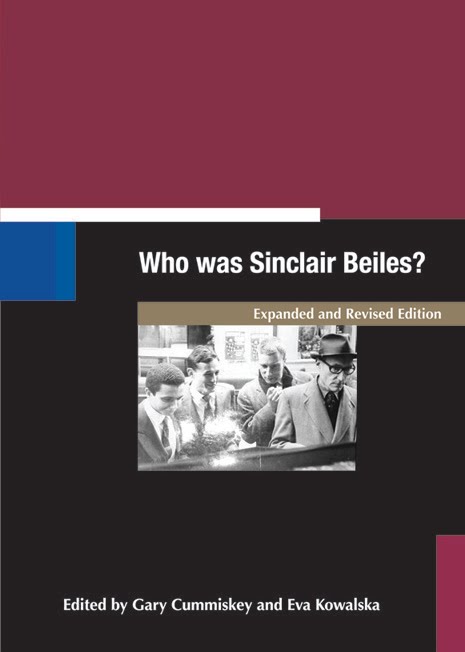
There’s more than a touch of self-importance in the way they pose for the photograph. It’s most obvious in the way they hold their cigarettes, like would-be film stars – Humphrey Bogart, Yves Montand, with a touch of Montgomery Clift. But you can also detect a sense of achievement; the idea that they have stumbled upon something revolutionary and sublime.


The date is 13 April 1960. The place is the English Bookshop in the Rue de Seine on Paris’ Left Bank, a few blocks from their informal headquarters, a nameless flea-ridden lodging a.k.a. the Beat Hotel. On the left of the black and white picture you see Swiss-born Canadian surrealist Brion Gysin. For a guy with a bitchy reputation he seems almost jovial, saying something to William Burroughs who is standing next to him, looking pale and gaunt, as befits the author of two controversial novels, Junky and The Naked Lunch. Spring has set in, but Burroughs is still wearing his hat and long coat. Digesting Gysin’s wit, he manages a faint smile, which makes him look momentarily handsome ... Read more.

Tuesday, January 26, 2016

Review of Who was Sinclair Beiles? by Dawn Swope

This little book grows and grows. It is a revised and expanded edition, the third edition in all. The book
first surfaced in 2009.

Little was known about Sinclair Beiles outside of his home country, South Africa. He got a name largely by being around Burroughs, Gysin, Ginsberg and Corso at the ‘Beat Hotel’ in Paris in the 1950s. There were photos of them all together. Beiles collaborated on the cult book Minutes To Go in 1960. There were conversations about books in the pipeline. Beiles worked at the Olympia Press, famous of course for Maurice Girodias and Junkie and other things.

Beiles never quite established his name in Europe and he struggled in his homeland also. His Ashes of
Experience won prizes but caused few ripples anywhere.

But he had a gift and a band of people did believe in him over the years. Gary Cummiskey for one, Fred de Vries, Carl Weissner, Heathcote Williams. They all befriended Beiles through Europe, Amsterdam, London, Greece, South Africa.

Beiles was hampered by his drug consumption, his personal issues. He was always on the cusp of something. He was a casualty of the literary world, a sometime Syd Barrett figure. A nearly man.

Gary Cummiskey and Eva Kowalska have researched and then some more to strip away the layers of time and fog around Beiles. More understanding, photos, bibliographies, letters. Well done to them.

Published in Beat Scene no 80, December 2015


Sunday, June 28, 2015

Sinclair Beiles, le poète excentrique du Beat Hotel, by Bruno Sourdin

Né en 1930, le poète sud-africain Sinclair Beiles a vécu à Paris dans les années 50. Il travailla pour Olympia Press, la maison d’édition de Maurice Girodias, qui publiait en anglais des livres sulfureux et subversifs, à la fois des récits érotiques (dirty books) et des oeuvres interdites aux Etats-Unis (parmi lesquelles Sexus d’Henry Miller, Lolita de Nabokov et Naked Lunch de William Burroughs). Sinclair lui-même a édité un roman érotique, Houses of Joy, sous le pseudonyme de Wu Wu Ming....Read more

Monday, April 13, 2015

Sinclair Beiles: Poet of Many Parts and Places, by Jan Herman


Dye Hard Press has re-issued Who Was Sinclair Beiles? in a revised and expanded edition. I posted an item about the first edition when it was published five years ago. It’s hard to believe so much time has passed. As I wrote then, Beiles was best known for his association with the Beats. He collaborated on Minutes to Go with William Burroughs, Brion Gysin, and Gregory Corso, and helped to shepherd Burroughs’ manuscript of Naked Lunch into print at the Paris-based Olympia Press, where he worked as an editor. “Best known” is a questionable term, though. If he was known at all, it was only among a certain segment of avant-garde expatriate writers and artists living in Tangier, Paris, London, Rotterdam, Athens, and other far-flung places, where he spent many years scraping by in various capacities....Read more

Tuesday, March 17, 2015

Sinclair Beiles: a man apart by Josh Medsker


Sinclair Beiles was a South African writer associated with the Beat movement of the late 50s and early 60s. During the time of his earliest successes, he moved from South Africa to Paris, to live with the community of writers and artists, which included Gregory Corso, Brion Gysin, and William Burroughs, among others, at what would become known as The Beat Hotel. Yet, this “beat” tag could not contain him. He also spent the early 60s in Greece, working with the Greek artist Takis on multimedia works, all the while spooling out his own brand of surrealistic, enigmatic poetry. He floated around Europe in the decades that followed… coming back to his homeland in the 90s, settling down in the artists’ enclave of Yeoville, in Johannesburg. He continued to experiment restlessly, until his death in 2000. He is relatively unknown outside of Beat and South African literary circles. Hopefully this article will go a long way towards correcting that. More .

Friday, September 19, 2014

Bailes [sic] emerges from mentor's shadow


Shocking typo in the headline! From The Star, 6 February 1997 

Friday, September 5, 2014