Monday, August 19, 2024
Sinclair Beiles in Cape Town
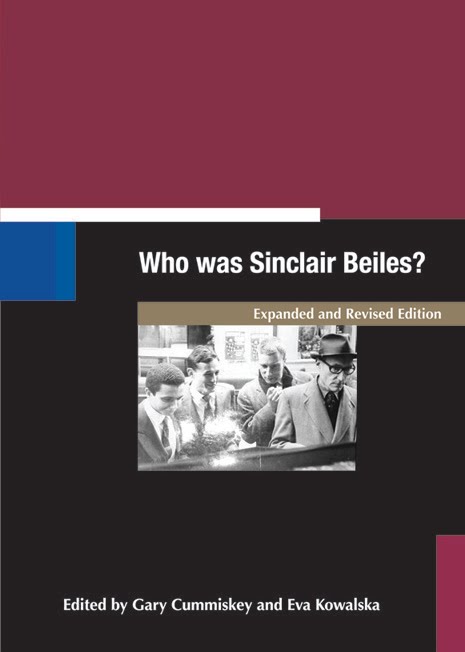
Good to see that Gregory Penfold in Cape Town has received his copy of Who was Sinclair Beiles?, published by Dye Hard Press.
Thursday, October 5, 2023
Glowing review of Who was Sinclair Beiles?
I found this glowing review of Who was Sinclair
Beiles? on Goodreads today: I certainly could not have asked for more!
Thank you, Mat!
**************
An excellent 'festschrift' (or 'celebration'), rather
than a strict biography, on the mysterious South African beat writer, Sinclair
Beiles.
Beiles is probably most famous for helping Burroughs get Naked Lunch published at Olympia through Girodias, at a time when Burroughs was really strung out on paregoric and/or heroin. His most famous work in print is probably as one of the four contributors (Beiles, Burroughs, Corso & Gysin) of the now legendary cut-up compilation, Minutes to Go, published in 1960.
One of his books of poetry, Yeoville, for example, was only published in a limitation of 4 copies.
What Beiles has in common with Burroughs is their meeting in Tangier and in Paris, an interest in drugs, an interest in experimental artists and writers and also, interestingly, a regular allowance from their families which allowed them both to focus much time on their writing.
I hope this book goes some way to revealing more about this great writer to the literary world. His poetry and plays have been criminally neglected and underrated and it is high time that his work is evaluated alongside many of the other great beat writers who are already firmly and undeniably well ensconced in the beat cannon and annals of history (in particular Burroughs, Kerouac and Ginsberg).
Gary Cummiskey and Eva Kowalska have done a terrific job of compiling these (mostly flattering) articles on Sinclair and his art. This is the best introduction to a little-known artist.
If you can obtain a copy, I recommend getting the second edition which is revised and expanded and contains an excellent bibliography-in-progress of Beiles' works in print.
Sunday, September 25, 2022
Raymond Foye writes about Who was Sinclair Beiles?
Burning the midnight oil with SINCLAIR BEILES, a wonderful poet who I always heard about, but knew very little about. A South African poet who lived at the Beat Hotel and was the editor of Naked Lunch + Samuel Beckett, at Olympia Press, followed by many years of mental illness which he often documented in his poems. Thanks to Gerard Bellaart for sending this book, full of essential information and many poems.
Wednesday, March 3, 2021
Sinclair Beiles and the Beat Generation
A new article about Sinclair Beiles has been published in New Frame, and Who was Sinclair Beiles?, which was published by Dye Hard Press, gets a mention.
The article starts: The 1950s were a tumultuous time for
an Australian criminal and con artist called William Lindsay Pearson. An array
of jewels was stolen from Brenthurst, the Johannesburg estate of the
Oppenheimer family, founders of the Anglo American mining giant, in 1955. This
treasure was, ultimately, derived from political connections to the apartheid
state and the exploitation of Black workers. ... more.
Friday, January 30, 2015
Out now: Who was Sinclair Beiles?, revised and expanded edition.
Available from Dye Hard Press at R150 per copy, including postage (South Africa only). Email dyehardpress@iafrica.com. For overseas orders, price will vary according to increased postal rates - please enquire with publisher.
Friday, August 22, 2014
Tuesday, July 30, 2013
Michael Adamis - Sinclair Beiles: collaboration on Genesis
Thursday, March 18, 2010
Excerpts from Who was Sinclair Beiles? on RealityStudio
Friday, February 26, 2010
Tuesday, February 23, 2010
Jan Herman on Who was Sinclair Beiles?
Thursday, September 17, 2009
Interview with Gary Cummiskey and Eva Kowalska about Who was Sinclair Beiles? on Litnet
Read more here
Saturday, September 12, 2009
Berold on Beiles

I thought the Beiles book was excellent - nice balance of interviews and essays, thorough bibliography, well edited, good design, readable and inviting. And as far as I know the first non-academic book about poetry to appear in South Africa for years (ever?). Definitely not a booklet as Stephen Gray called it in his M&G non-review. I wish all our poets got such attentive treatment.
It's sad that Beiles's work and his mental state went kind of downhill. But he did write some good poems -the best of them of full of startling images, going off on tangents in interesting ways. An aesthetic that no other South African was doing. And he wrote about his madness with courage and humour.
I had a few meetings with him, and like everyone else, had to deal with his erratic attitude (which started with his proclaiming me a great poet and degenerated over time to the death threat 'by spells' quoted in Dawie Malan's essay).
Once when I was visiting him, he said "Would you like a suitcase?" and produced a very battered very heavy leather suitcase. Which my computer monitor now sits on - so I live with a reminder of Beiles every day.
Perhaps in his later years, his real creation was a character called Sinclair Beiles. But I hope Dye Hard will prove there was also a poet called Sinclair Beiles by publishing a 'best of' selection.
Saturday, August 15, 2009
Editors' introduction to Who was Sinclair Beiles?
In biographies of the major American Beat writers, such as William Burroughs or Allen Ginsberg, Beiles is often given a mere walk-on part. For example, in Barry Miles’s detailed The Beat Hotel, more attention is given to writers who were not even involved in the Minutes to Go collaboration. Thus Beiles is represented as, to use Joyce Johnson’s phrase, a minor character. Even in South Africa his work is almost totally ignored, and it is hoped this book will lead to some serious consideration of Beiles the poet.
Who was Sinclair Beiles? is not a biography, nor does it pretend to be an authoritative work about him. It is intended rather as a tribute, and was produced while keeping both financial and time constraints in mind. When I invited Eva Kowalska – who is completing her Master’s degree on Beiles’s work – to come on board as co-editor, she, like myself, was restricted by the demands of a fulltime job and other responsibilities. So, with a few exceptions, we opted to use previously published or readily available material.
The first part consists of memoirs about, and interviews with, Beiles by malan, Earle Holmes, George Dillon Slater and myself. In the second part of the book, Kowalska examines Beiles’s poetry with an emphasis on his relationship to the American Beat poets, while in a review of the Beat Hotel Exhibition in Johannesburg, Finlay provides a snapshot of Beiles in the Rockey Street milieu in the mid-1990s. Fred de Vries, who is working on a biography of Beiles, describes some of his journeys and interviews in Africa, England and Europe as part of his research. Lastly, we examine some of the reasons for Beiles’s relative obscurity and provide a bibliography of his publications.
There is some overlap in the book, particularly in the interviews. Editorial cuts have however been kept to a minimum.
Gary Cummiskey
My experience of undertaking a study of Sinclair Beiles’s writing has been frustratingly, but intriguingly, devoid of much useful secondary material. There is very little information available about Beiles, much less so about his work. Many people know of him, though not really about him, and, aside from a handful of reviews of his earlier collections, notably Ashes of Experience, he seems to have become a name without a presence in South African literary culture. This is
unfortunate, because in addition to a colourful reputation Beiles left behind a considerable amount of poetry and plays. Though admittedly it is uneven in quality, I have found his writing to be innovative, humorous, and genuine. Though he is remembered primarily as a poet, his plays and dramatic fragments, a handful of which were staged during his lifetime, reveal a versatile writer with a talent for satire and an unusual outlook which remains interesting beyond its original context.
My involvement in this project came as a result of perceiving a lack of material on Beiles, be it factual biography or any real consideration of his work. I see Who was Sinclair Beiles? as an opportunity to do something towards remedying that gap. Secondly, it was out of a desire to assert Beiles as a poet worth considering, remembering, studying, writing about – someone who should not continue to be left out of our conceptualisation of South African and/ or Beat literature.
Rather than being a complete summary of Beiles as a person and a poet, which would be impossible, or a thorough appraisal of his life and his writing, which would be a vast and entangled project, I hope that this book is a start in the right direction. I hope that it will encourage others to reinvestigate Beiles’s writing, and that it might be useful to them in doing so. I feel that it goes some way towards establishing the worth of a poet who has been almost systematically ignored on his home ground. Through the previously published texts and new perspectives offered it might provide a context or a framework for understanding and appreciating a writer who has long been preceded by his reputation to the detriment of knowledge and appreciation of his art.
Eva Kowalska
Wednesday, July 15, 2009
New publication from Dye Hard Press: Who was Sinclair Beiles?
edited by Gary Cummiskey and Eva Kowalska
In 1960, William Burroughs, Gregory Corso, Brion Gysin and Sinclair Beiles collaborated on the now legendary collection of cut-ups, Minutes to Go. Readers of Beat literature know of Burroughs, Corso and Gysin, but who was Sinclair Beiles?
Sinclair Beiles was a South African poet and playwright, born in Uganda in 1930. He moved to Paris during the 1950s, where for a time he was an editor at Olympia Press and a resident at the Beat Hotel. He later spent several years in Greece and his first poetry collection, Ashes of Experience, won the first Ingrid Jonker poetry prize in 1969. Many other collections followed, published either overseas or in South Africa, to where he returned in the late 1970s. Beiles died, generally ignored by the mainstream South African poetry anthologies, in Johannesburg in 2000.
Who was Sinclair Beiles? brings together a collection of interviews, memoirs and essays about Beiles and his work by Gary Cummiskey, dawie malan, George Dillon Slater, Earle Holmes, Eva Kowalska, Alan Finlay and Fred de Vries.
The book also includes previously unpublished photographs of Sinclair Beiles. Perfect bound, 136 pages. Beiles's work is in danger of sliding into obscurity forever, and it is time for a renewed assessment of his contribution to South African literature.
Who was Sinclair Beiles? will soon be available at bookstores throughout South Africa, estimated retail price R160. If purchased directly from the publisher, the price is R100, including postage (South Africa).
E-mail dyehardpress@iafrica.com for more order details.


.jpg)